For review · nothing ordered yet
The backyard,
after dark
Why the lights we keep buying don't work, what we'd do instead, and what each version costs.
Where we are now
Taking the dog out at night is genuinely annoying. The two motion floodlights light up one cone and everything past it is black. The solar stakes along the fence were dim the day we put them in and they've gotten worse every season. The stairs down from the deck are the part that actually worries me — there's no light on them at all. And the light by the back door has been dead for months.
We know why that one's dead now. It's the next section, and it's the one thing here that isn't just an inconvenience.
The back door light — and why it needs dealing with first
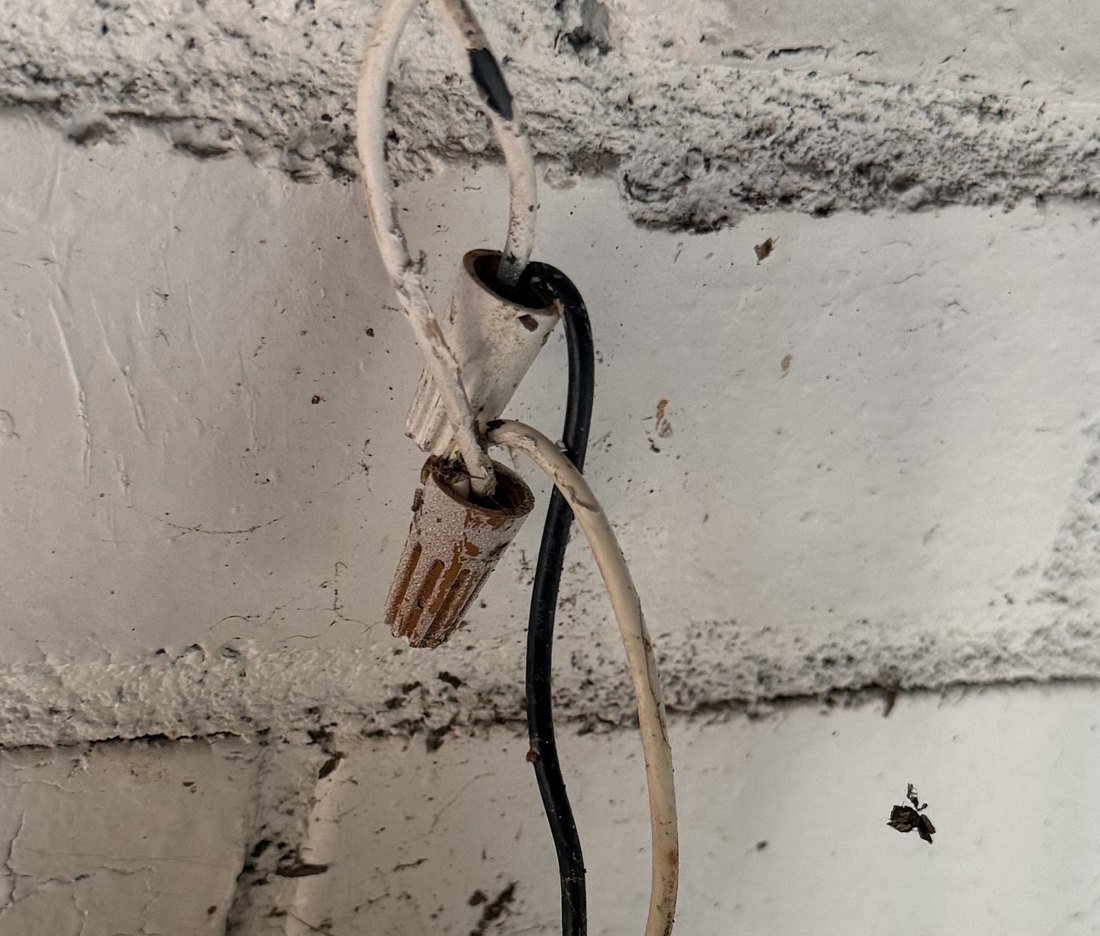
The fixture isn't attached to the wall any more. It's hanging by its own two wires, and the connections — those two plastic caps in the photo — are just dangling in the open air. There's no box behind them, which is the part that's supposed to hold and protect all of it.
Look closely and the wires are cracked and flaking, the caps are loose enough that you can see bare wire coming out the side, and there's dirt packed inside them. That's why a new bulb and flipping breakers did nothing — neither of those was ever the problem. The break is in those two inches of wire.
Please don't touch it in the meantime, and keep the dog away from that bit of wall.
A light being dead does not mean the wires are dead. Depending on which side failed, one of those wires can still be live — outdoors, at head height, over a wet patio. It needs the breaker off and a tester before anyone goes near it.
The fix is small. An electrician puts in a proper weatherproof box, redoes the connections inside it, and hangs a real outdoor-rated fixture on it. An hour or two, in the same range as any service call. Worth doing before anything else, because a working light at that door is the cheapest, brightest light we'll ever get back there.
One genuinely good surprise while we were looking: the outdoor outlet under the porch is a proper weatherproof GFCI with the right cover — exactly what the whole lighting system below needs to plug into. That part we don't have to touch.
Why the solar lights don't work here
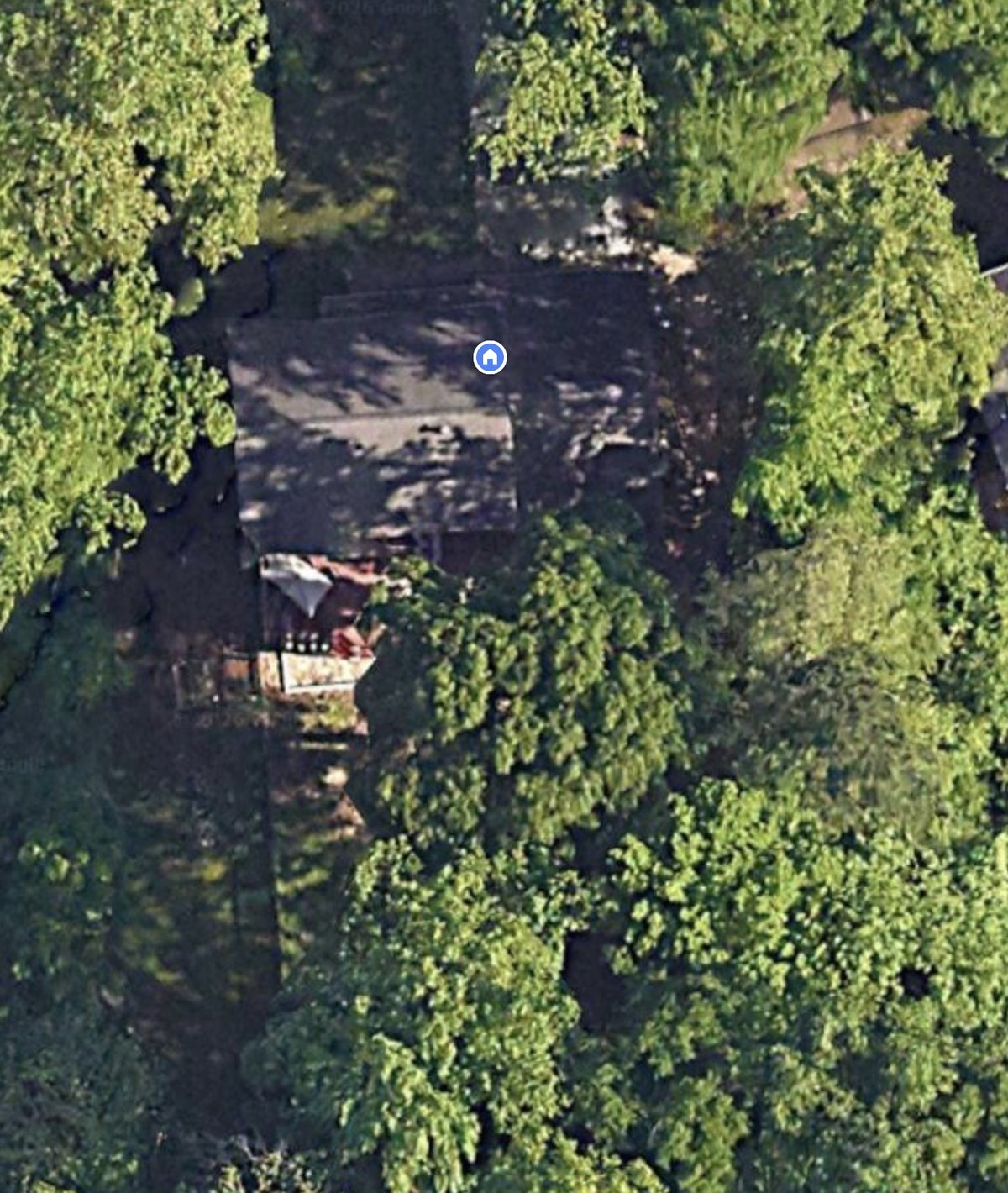
A solar light spends the day charging a small battery and the night spending it. To get the runtime printed on the box, it needs something like six hours of direct sun.
We have trees everywhere. Between the trees and the house, the stakes along the fence get a couple of hours of broken light on a good day. So they start the evening part-charged, they're dim, and they're finished well before we go to bed. A battery that never gets a full charge also doesn't last as many seasons, which is why they've gotten worse instead of staying the same.
The thing worth knowing: spending more on solar lights doesn't fix this. The sun is the limit, not the light. That rules out basically the whole category, because almost every solar fixture has the panel built into it.
The good news
The yard lighting itself needs no electrician, no trench, and no new wiring. (The broken door light above is the one exception, and it's a separate small job.)
There's a whole category of outdoor lighting that runs at 12 volts — the same as a car battery — and it's what actually gets installed at nice houses. A small transformer plugs into an outdoor outlet we already have, and the cable tucks under the mulch. No permit, no electrician, nothing gets dug up.
We know the outlet works: it's the one under the porch with the bug zapper on it. One transformer covers about 115 feet of cable, which reaches the whole back yard from there.
And once it's plugged in, all those trees stop being the problem and become the best thing we have to light.
Three ways to do this
Put rechargeable D batteries and a charger in the two floodlights. They eat four D cells each every few months, which is why we keep having to buy them — rechargeables end that errand for good. Then re-aim the three heads so they cover three different areas instead of all pointing at the same spot.
Noticeably better this week. Still not actually good, and it doesn't do anything for the steps or the rest of the yard. Nothing here is wasted if we do more later.
Buy the transformer and the cable at full size up front — that's the backbone and you don't want to redo it. Then start with the two things we feel every single night: the stairs down from the deck and the path out into the yard.
Add the trees, the stone, and the shed later, a few at a time, whenever we feel like it. Same backbone, no rework, no big single hit.
Nineteen fixtures, the entire yard, one weekend of work. There's a 50%-off code running on the fixture site right now — it says "selected items," so we'd have to see what it actually covers, but it could take a real bite out of this.
Or ~$693 the Home Depot way — same six zones, Hampton Bay instead of brass, mostly in stock locally. Both versions are laid out side by side at the bottom.
What it would actually look like
The stairs down from the deck
Small lights set into the risers, throwing light down onto each tread. You see the steps themselves instead of getting a spotlight in your eyes. This is the zone I'd do first — it's the safety one.
The path out to the yard
Low path lights, staggered side to side rather than lined up like runway markers, about eight feet apart. Warm light at ankle height.
The stone — the seat walls around the patio
Flat bar fixtures tucked up under the stone caps so light washes down across the wall face and you can read the texture of it. The low walls and the square piers ringing the patio are made for this. Not the stick-on LED strip you see online — outdoors that peels off, yellows, and fills with water within a season.
The trees — this is the part that changes everything
Uplights at the base of five or six trunks, aimed straight up into the branches. Then one or two lights mounted high in a tree pointing down, which filters through the leaves and reads like moonlight. This is the difference between a yard with lights in it and a yard that looks designed. It's also the cheapest drama available to us, because we already have the trees.
The shed
One wide wash across the face so it stops being a black shape at the back of the yard.
The fence
Honestly, last. Lowest value on the list. Easy to add later, easy to skip.
The third motion light — it should go on the stairs
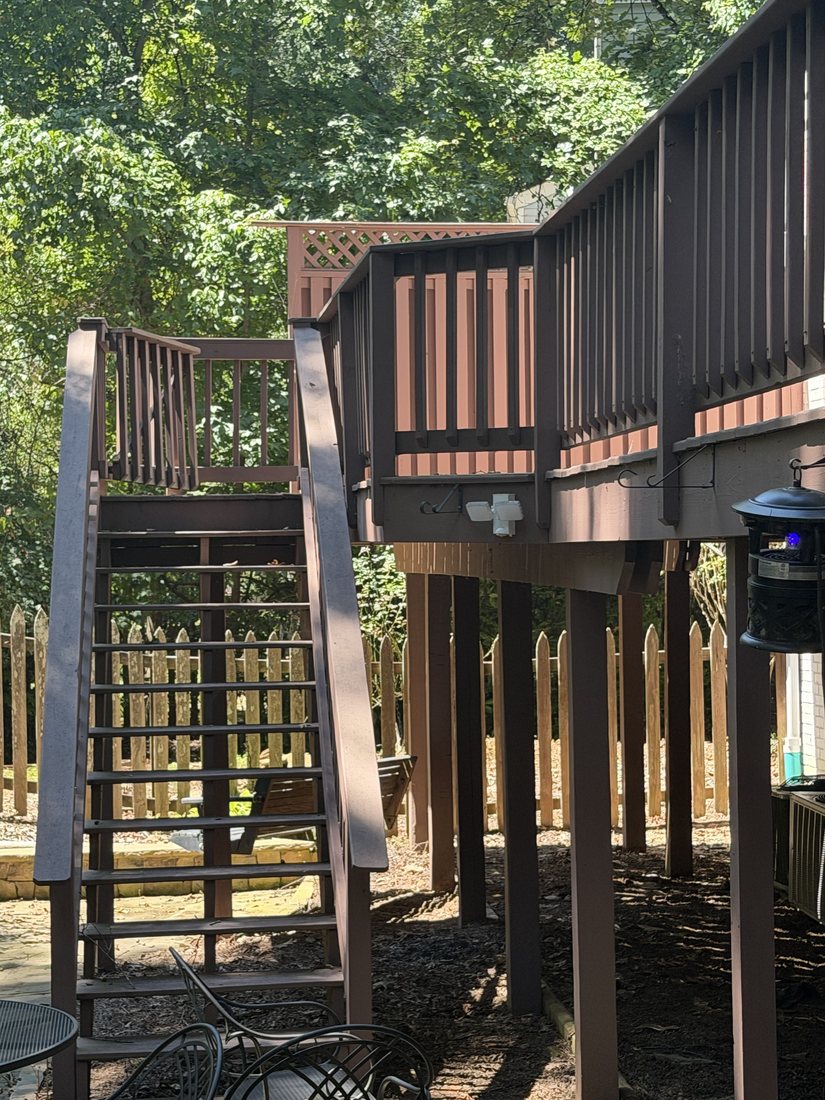
We have two of these up already: one on the deck edge over the patio, one above the shed doors. The gap is the stairs — a long open flight with no light on it whatsoever, and the likeliest place in this yard for someone to actually get hurt.
It should go on the deck framing beside the top part of the stairs, aimed down at the treads, so the light comes from above and behind you on the way down. Mounting it at the bottom pointing up would just put the glare in your eyes and leave the steps in shadow.
One practical thing: it eats four D batteries every few months, so it has to be somewhere reachable without dragging a ladder out. Beside the stairs means we can get to it from the stairs. And it's a stopgap either way — proper step lights replace it when we do the real thing.
How it turns on
Two layers, and we already own the second one.
The low-voltage lights come on at dusk and stay on soft all night. That's the layer that makes the yard look good and means you never walk out into pitch black.
The two motion floodlights stay exactly where they are and punch bright when the dog moves. We don't need to buy anything smart, wire anything, or add another app.
What we're deliberately not doing
- No more solar stake lights. Same sunlight problem, nicer box.
- No stick-on LED strip on the stone. It fails outdoors, reliably.
- No electrician, no trenching, no permits — for the yard lighting. Only the broken door fixture needs a trade.
- No Philips Hue fixtures out in the yard. Roughly double the price, and the affordable ones are much dimmer than they photograph. We'd keep Hue on the porch only.
The one thing we still have to measure
How far is it from the outlet under the porch to the farthest tree we'd want lit? Under 80 feet, the transformer below is the right one. Farther than that and we need a slightly different one, or the lights at the far end come out dim and a bit off-colour. It's the only open question before anything gets ordered.
The actual shopping list
Three ways to buy it. Same idea and same wiring in all of them — what changes is the fixtures, the price and how long they last. Pick a tab.
Everything from one place, Gardenreet. Solid brass and cast aluminum rather than plastic, free shipping, 60-day returns. Prices checked 22 August 2026.
The backbone
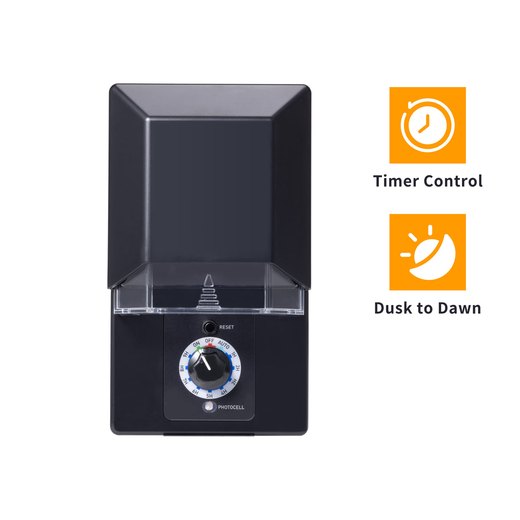
Dual-Tap Transformer — 200W
The box that plugs into the outlet under the porch and feeds everything else. Buy the 200W, not the 100W — the smaller one would run too close to its limit and leaves no room to add lights later.
The trees
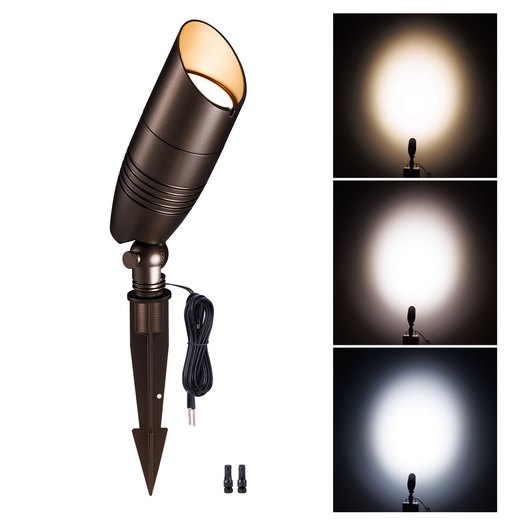
Adjustable Spotlight (9105)
Stakes into the ground at the base of a trunk and aims up into the branches. The single biggest visual change we can make. 4.7 stars across 423 reviews.
The stairs
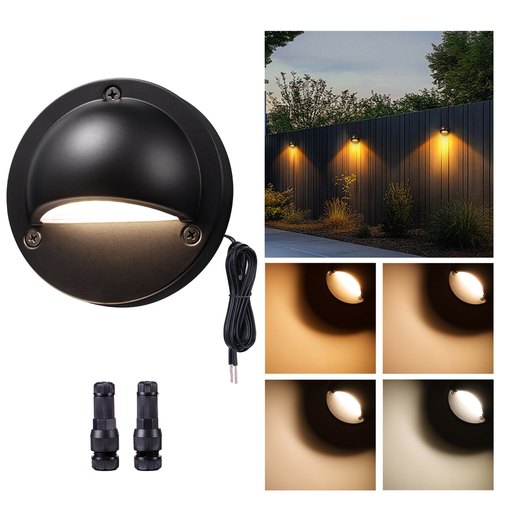
Deck & Step Light (9301)
Mounts into the stair risers and washes light down across each tread. Also works on the fence or a railing if we want it later.
Fancier: the solid brass version is $77.90 each — nicer, roughly double.
The stone
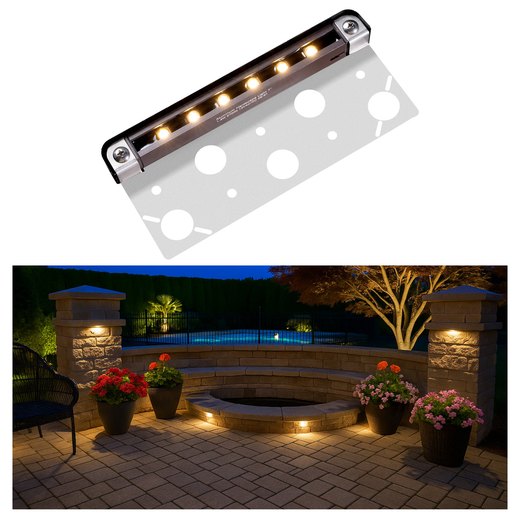
Pivoting Hardscape Bar Light, 7″
The proper version of the "light strip" idea. A rigid bar that tucks under a stone edge and pivots to aim the wash exactly where we want it. Comes in 3″, 7″ and 13″.
Fancier: cast brass, 7″ at $48.99 each.
The path out
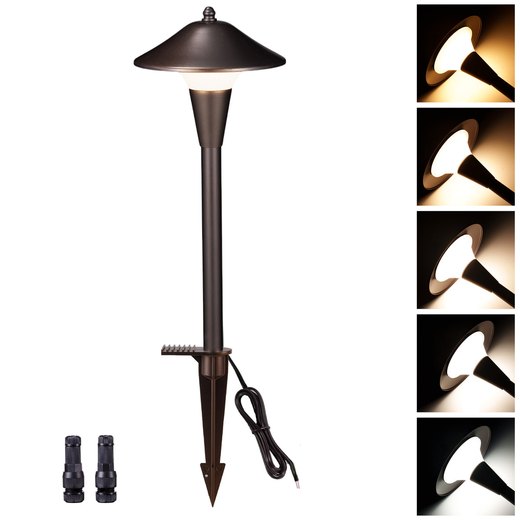
Pathway Light (9406)
Ankle-height light along the walk out to the yard. 200 lumens, and you can pick how warm the light is after it arrives.
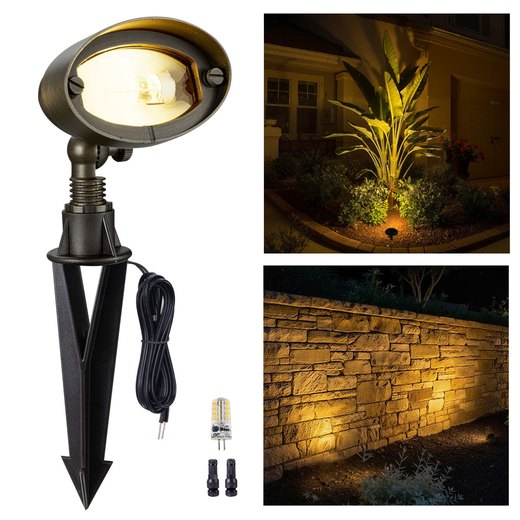
The shed
Brass Flood & Wall Wash (2301)
Wider beam than the tree spotlights — throws an even wash across the face of the shed so it reads as a building instead of a dark shape.
Plus about $139 of 12-gauge direct-burial cable and waterproof connectors from Amazon — unglamorous, but it's what keeps the far lights as bright as the near ones.
| What | Qty | Cost |
|---|---|---|
| Transformer, 200W | 1 | $104 |
| Tree uplights | 6 | $162 |
| Step lights | 4 | $160 |
| Bar lights for the stone | 4 | $148 |
| Path lights | 4 | $80 |
| Wash light for the shed | 1 | $49 |
| Cable and connectors | — | $139 |
| Everything, before any discount | 20 | $842 |
Solid brass outdoors lasts decades and develops a patina rather than corroding. That longevity is the whole argument for this tab.
All Hampton Bay, all from Home Depot. Cast aluminum rather than brass, and most of it is in stock at Merchants Walk — so this version can start this weekend. Prices checked 24 August 2026.
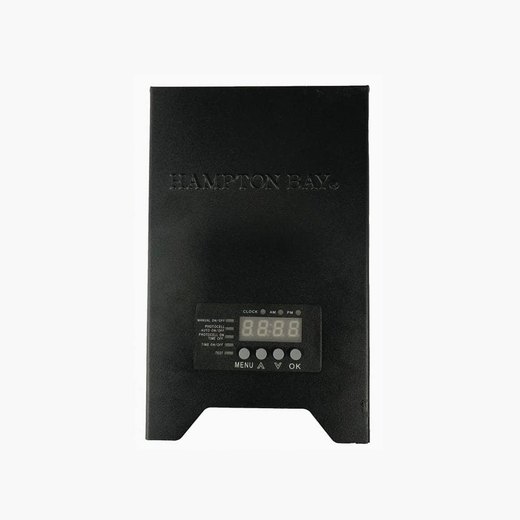
The backbone
Hampton Bay 300W Metal Transformer
Corrected — Jay was right, the 120W was too tight. This one is metal-cased, has a photocell and digital timer, and splits into three separate zones, so the stairs, the patio and the far trees can each be switched on their own run.
Cheaper middle option: the 200W at $94.97. The old 120W at $58 is not recommended.
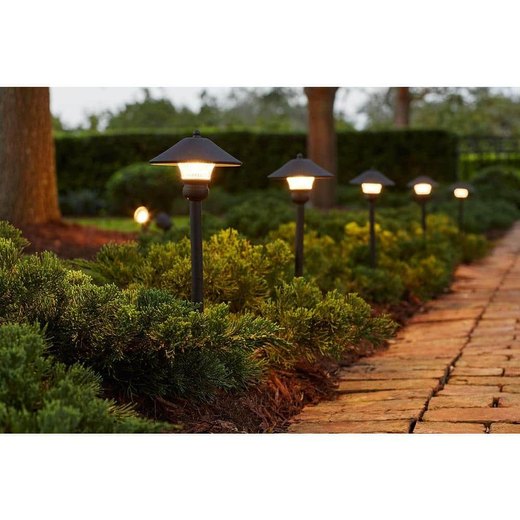
The path out — and a head start
Pearson Kit — 6 path lights + 2 floods
The single best-value box here. Six 205-lumen path lights (brighter than the brass tab's) plus two floods, in one kit. 961 reviews.
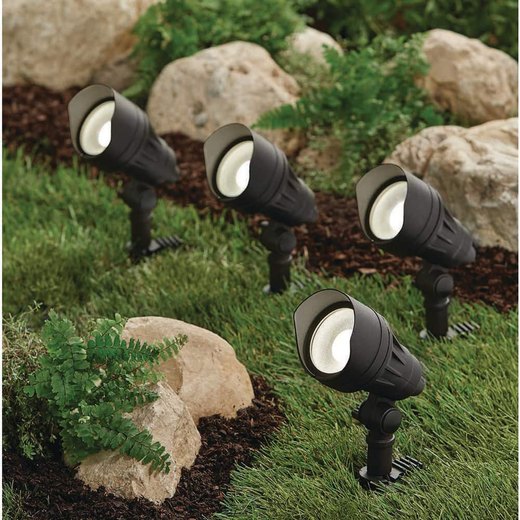
The trees + the shed
Millennium 390-Lumen Flood (4-pack)
The uplights. Cast aluminum, adjustable head, and you pick the warmth of the light on the fixture itself. 390 lumens each is brighter than the brass tab's spotlight. 4.6 stars, 1,571 reviews.
Was $129 — currently $24 off.
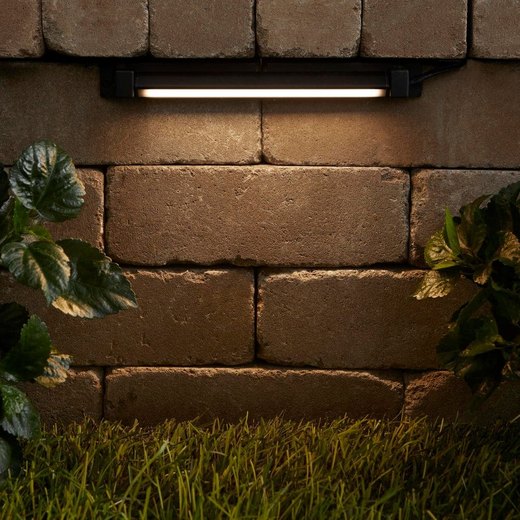
The stairs and the stone
Stair Light (3-pack), with hardscape adapter
The clever one. It ships with a hardscape adapter bracket, so the same fixture screws to the stair risers and tucks under the stone caps. One product covers both zones. 4.7 stars.
Was $83.97 — currently 15% off. $23.79 a light.
The unglamorous bit
Southwire 12/2 Landscape Wire, 250 ft
Same wire either way — this is what keeps the far lights as bright as the near ones. Buy the 250 ft roll; running short mid-project is miserable.
Other Home Depot options, if you want to swap something
Same system, different fixtures. Prices checked 24 August 2026.
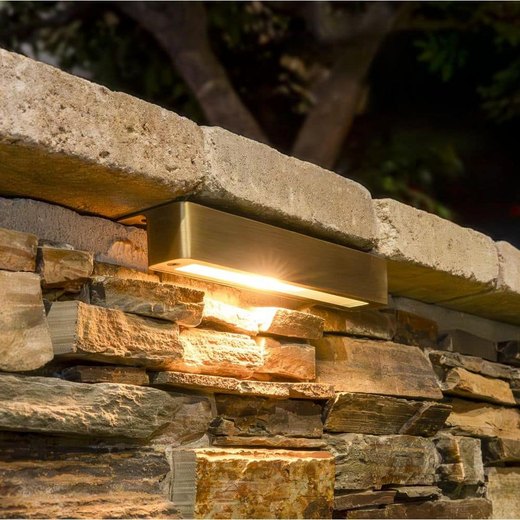
Upgrade · the stone
VOLT Brass Hardscape Light
Home Depot sells solid brass too. This is the proper pro hardscape fixture, made to sit under a capstone. If you want the brass tab's longevity on the stone without ordering online, this is the way.
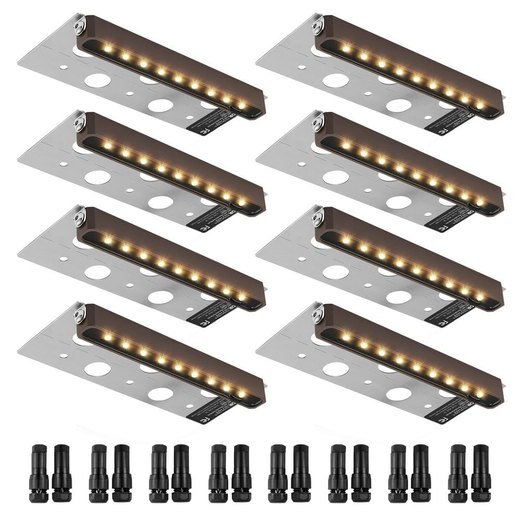
Budget · stairs + stone
VEVOR Hardscape Step Light, 8-pack
Eight swivel step lights with connectors for less than the price of two Hampton Bay 3-packs — about $9 a light. Unknown brand and no track record, but it would cover both zones in one box.
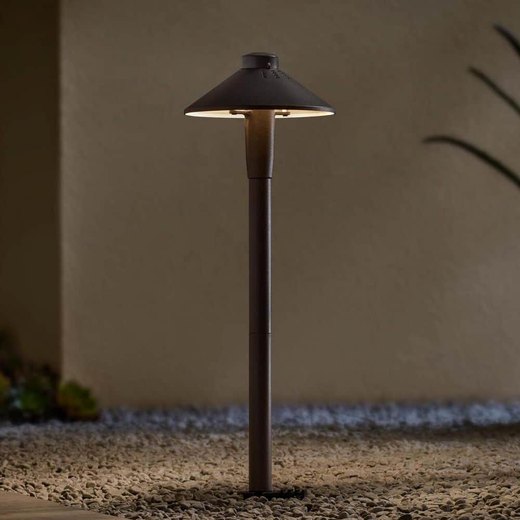
Brighter · the path
Clyde Park 210-Lumen Path Light
If the Pearson kit's path lights feel dim once they're in, these are the brightest Hampton Bay path light and you pick the warmth on the fixture. Sold singly, so you can buy one and look at it first.
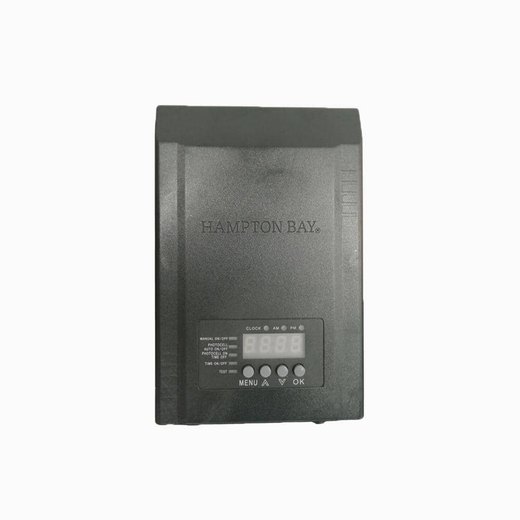
Not recommended
The 120W Transformer — why it's out
This was in the first version at $58. Running the numbers properly, this fixture list draws roughly 70–80W. The rule of thumb is to stay under 80% of a transformer's rating, which puts 120W right at the edge with nothing left to add later. The 300W removes the question.
| What | Qty | Cost |
|---|---|---|
| Transformer, 300W (3 zones) | 1 | $129 |
| Pearson kit (6 path + 2 flood) | 8 | $159 |
| Millennium floods (trees, shed) | 4 | $105 |
| Stair lights (stairs + stone) | 6 | $143 |
| Wire, 250 ft | — | $132 |
| Waterproof connectors | — | $25 |
| Everything | 18 lights | $693 |
Honest comparison. This tab is about $150 cheaper, covers the same six zones with a near-identical fixture count (18 vs 19), is brighter in two zones — 205-lumen path lights and 390-lumen floods both beat the brass equivalents — and you can put most of it in the car today.
What you give up is lifespan. Cast aluminum outdoors is decent, not brass. Expect these to look tired in perhaps five to eight years where brass would still be fine in twenty. Home Depot's return window is 90 days versus 60 mail-order, which cuts the other way.
Lowe's house brand for this is Harbor Breeze (Portfolio, the name you'd remember, is basically gone). Their range is thinner than Home Depot's — but they have the single cheapest way to get lights in the ground. Prices checked 24 August 2026.
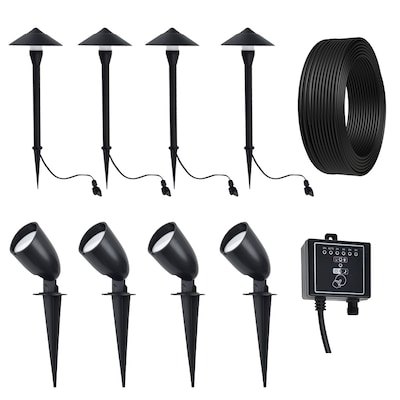
The cheapest possible start
Harbor Breeze 4 Spot + 4 Path Kit
Eight fixtures, a transformer and the cable, all in one box for seventy-five dollars. Nothing else on this page comes close on price per light — it works out about $9 a fixture with the power supply thrown in.
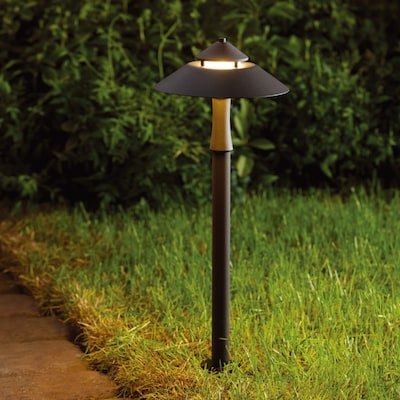
The path, individually
Harbor Breeze 90-Lumen Path Light
Metal construction with a frosted glass lens — genuinely nicer material than most of the plastic in this price range. 3000K warm white. Sold one at a time.
Read the kit's fine print before you fall for the price. The transformer inside it is 35 watts, and it's 15V DC — not the 12V AC that every other fixture on this page runs on.
In plain terms: that kit is a sealed little world. It'll light eight spots nicely and it is a genuine bargain, but you can't add our stair lights to it, you can't grow it, and when you outgrow it the transformer is landfill. It is not the first step of the bigger system — it's an alternative to it.
Where Lowe's actually lands. They win decisively on the cheap start and lose on the full build. Their individual low-voltage fixtures run $33–$35 each against roughly $20–$27 for the Hampton Bay equivalents, and I couldn't find a serious Lowe's-brand transformer in stock at all — so a full six-zone Lowe's build would cost more than either other tab and you'd still be buying the transformer somewhere else.
Honest use for this tab: if we want to spend $75 this weekend, put eight lights in the ground, and see whether we even like lit trees before committing — buy the kit. Just go in knowing it's a dead end rather than a foundation.